Stocks vs Bonds: What's the Difference for a Beginner?
Here is the short version. A stock makes you a part-owner of a company. A bond makes you a lender to a company or a government. That single distinction, owner versus lender, explains almost everything else about how the two behave: which one swings more, which one pays you a set amount, and why most portfolios hold both. Get that one idea and the rest falls into place.
If you have heard the phrase "stocks and bonds" a thousand times without anyone explaining what each actually is, this is the plain-English version.
What is a stock?
A stock, also called a share or equity, is a small slice of ownership in a company. Buy one share of a business and you own a tiny piece of it. If the company does well and becomes more valuable, your slice becomes more valuable too. If it does badly, your slice shrinks.
Owners get two things:
- A claim on the upside. When the company grows, the share price can rise. Some companies also pay out part of their profits as dividends.
- The full ride, up and down. There is no promise you get your money back. Owners are last in line if things go wrong.
That is the trade. You take on the risk of ownership in exchange for an uncapped share of the reward. This is why stock prices bounce around so much day to day. You are along for every twist in the company's fortunes.
What is a bond?
A bond is a loan. When you buy a bond, you are lending money to whoever issued it, usually a company or a government, and they agree to pay you back on a set schedule.
A bond normally comes with two promises:
- Interest payments. The issuer pays you a fixed amount at regular intervals, often called the coupon. This is the "income" part of investing.
- Your money back at the end. On the maturity date, the issuer returns the original amount you lent, called the principal or face value.
So a bond is much more predictable than a stock. You are not sharing in the company's success. You just want to be paid back with interest, on time. A lender does not care whether the company triples in value. They care whether it can make the payments.

The one mental model: owner vs lender
Almost every difference between stocks and bonds comes back to this. Picture a small cafe that needs money to open a second location.
- If you buy equity in the cafe, you become a part-owner. If the second location is a hit, your stake could be worth a lot. If it flops, you might get little or nothing back. You share the outcome, good or bad.
- If you lend the cafe money as a bond, you are promised your money back plus interest, regardless of how busy the new location gets. As long as the cafe stays solvent, you get paid on schedule. But even if it becomes the most popular cafe in the city, you do not get a cent more than the agreed interest.
Owners get the upside and the downside. Lenders get a fixed deal and stand ahead of owners if the business runs into trouble. That is the whole thing.
How they compare
Here is the same idea laid out side by side. Treat the numbers as illustrative, not a forecast.
| Feature | Stocks (equity) | Bonds (debt) |
|---|---|---|
| Your role | Owner | Lender |
| What you hope for | Rising value and dividends | Steady interest and repayment |
| Typical volatility | Higher, can swing sharply | Lower, steadier |
| Long-run return (historically) | Higher on average | Lower on average |
| If the company fails | Paid last, may get nothing | Paid before owners |
| Income style | Variable dividends, if any | Fixed, scheduled interest |
| Main risk | Price falls, company struggles | Issuer defaults, or rates rise |
Notice the pattern. Everything you gain in one column, you pay for in the other. Stocks offer more potential reward and more stomach-churning movement. Bonds offer more stability and a lower ceiling. Neither is "better." They do different jobs.
Are bonds safer than stocks?
Usually, but "safer" needs a definition. On average, bond prices move less than stock prices, and lenders get paid before owners if a company goes under. So in a rough year, a portfolio with bonds in it tends to fall less than one made purely of stocks.
That said, bonds are not risk-free, and it is worth knowing the two main ways they can lose you money:
- Default risk. The issuer might fail to pay you back. A loan to a shaky company is riskier than a loan to a stable government, which is why riskier issuers have to offer higher interest to attract lenders.
- Interest rate risk. If interest rates in the economy rise after you buy a bond, newer bonds pay more, so your older, lower-paying bond becomes less attractive to sell. Its market price drops. You still get your interest and principal if you hold to maturity, but the value can dip in the meantime.
So the honest summary is: bonds are generally lower-risk than stocks, not no-risk. Markets can fall as well as rise, on both sides of the ledger.
Why most portfolios hold both
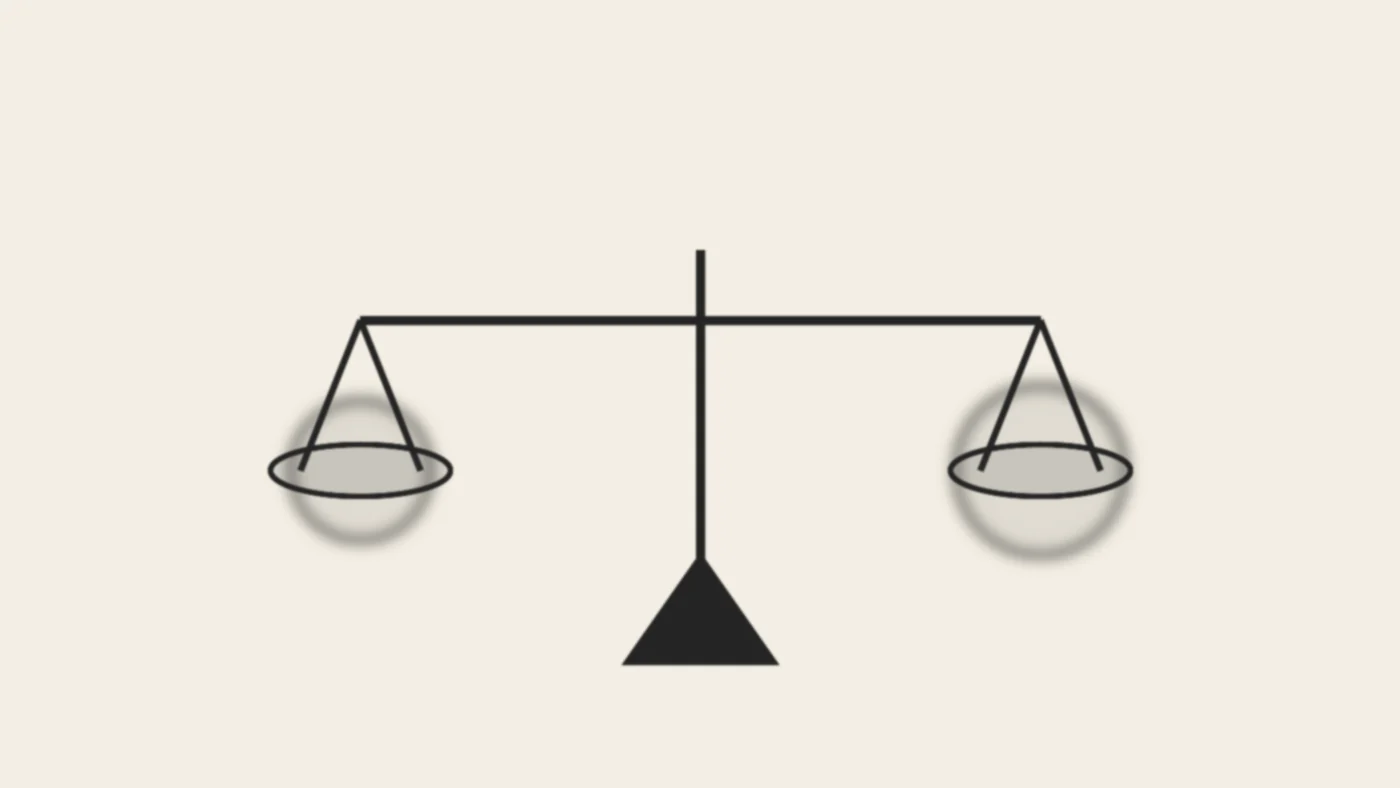
If stocks tend to grow more over the long run, why not hold only stocks? Because the two assets often behave differently at the same moment, and that difference smooths the ride.
Stocks tend to reward patience over years and decades. Bonds tend to hold steadier when stocks are having a bad stretch, and they pay predictable income along the way. Holding both means you are not fully exposed to one asset's worst moments. This is the basic idea behind diversification: mixing things that do not all rise and fall together.
The right blend for any one person depends on things like how long the money can stay invested and how calm they can stay when prices drop. A longer time horizon usually means more room for the ups and downs of ownership, because there is time to recover. Deciding that blend on purpose is called asset allocation, and it is one of the most important choices a new investor makes.
A worked example
Say you have 1,000 dollars to put to work. These figures are made up to show the shape of the trade-off, not a prediction.
- Put it all in stocks, and in a good year it might grow to 1,120 dollars. In a bad year it might fall to 820 dollars. Big range, both directions.
- Put it all in bonds paying 4 percent, and you would expect roughly 40 dollars in interest, so about 1,040 dollars, with far less bouncing around. Smaller range.
- Split it half and half, and your outcome lands somewhere in between, with a gentler ride than all-stocks and more growth potential than all-bonds.
The lesson is not that one number is right. It is that the owner path has a wider range of outcomes and the lender path has a narrower one, and mixing them lets you dial the ride to something you can actually live with. The steadier that ride, the more likely you are to stay invested long enough for compounding to do its work.
Key takeaways
- A stock makes you an owner. A bond makes you a lender. That single distinction drives every other difference.
- Owners get the upside and the downside. Lenders get fixed interest and their money back, and they get paid before owners if things go wrong.
- Bonds are generally less volatile than stocks, but not risk-free. Issuers can default, and rising interest rates can push bond prices down.
- Stocks have historically returned more over the long run, with much larger swings. Past results do not guarantee future ones.
- Most portfolios hold both, because the two often move differently and the mix smooths the ride. Choosing that mix is called asset allocation.
- Trying to jump between them based on predictions is its own trap, which is why timing the market usually backfires.
FAQ
Are bonds safer than stocks?
Bonds are generally less volatile than stocks because you are a lender with a fixed repayment schedule, not an owner riding the ups and downs. But safer does not mean risk-free. Bond issuers can default, and bond prices fall when interest rates rise.
Can you lose money in bonds?
Yes. You can lose money if the issuer fails to repay you, or if you sell a bond before it matures for less than you paid. Bonds are lower-risk than stocks on average, not no-risk.
Should a beginner buy stocks or bonds first?
This is education, not advice, so there is no single answer. Most beginners learn about both and then think about a mix that matches how long they can leave the money invested and how much bouncing around they can stomach.
What is the difference between a stock and a bond in simple terms?
A stock makes you a part-owner of a company. A bond makes you a lender to a company or government. Owners share in the upside and the downside. Lenders get paid back on a schedule, whatever the owner is doing.
Do stocks or bonds pay more over time?
Historically, stocks have delivered higher long-run returns than bonds, but with much bigger swings along the way. Past performance does not guarantee future results, and markets can fall as well as rise.
Understanding stocks and bonds is one of the first real building blocks of investing, and it clicks fastest when it is broken into small pieces. That is exactly what Brevity does. Our bite-sized lessons turn ideas like this into a few minutes a day, so the jargon stops being intimidating. Start learning at downloadbrevity.com. If you are still at the very beginning, our guide on how to start investing with $100 is a good next step.